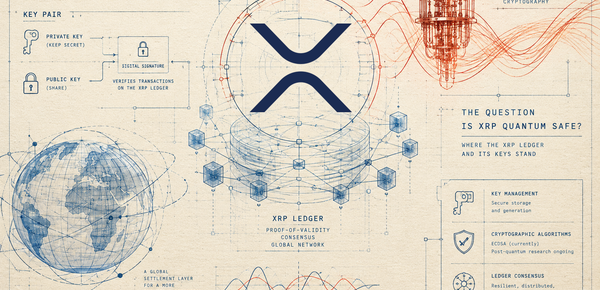
This guide covers where XRP's quantum exposure sits and where Ripple's 2028 roadmap stands, as of October 2026.
The quick verdict
XRP transactions are authorized by elliptic-curve signatures. The XRP Ledger supports ECDSA on secp256k1, the curve Bitcoin uses, and Ed25519. Wallet software decides which scheme it generates by default. Shor's algorithm, run on a large fault-tolerant quantum computer, can recover an elliptic-curve private key from its public key. That's the core exposure for XRP, the same kind of attack that threatens Bitcoin and Ethereum.
How XRP addresses handle the public key
Here's where XRP differs from a chain like Solana, where the address is the public key itself. An ordinary XRPL account's classic address encodes a 160-bit hash derived from its master public key. It's a RIPEMD-160 hash of a SHA-256 hash of that key, written in base58. Receiving XRP doesn't by itself disclose the key, as long as the key hasn't been shared or used elsewhere.
A signed transaction discloses its signing public key once the transaction becomes available to others, and validation records it on the ledger. For a regular-key transaction, that's the regular public key. Multisigned transactions disclose the participating signers' keys. Therefore, an account's own history can't establish that every key authorized to control it stays undisclosed.

An XRP address is a RIPEMD-160/SHA-256 hash of the public key, so the key stays hidden until the account signs its first transaction.
The rotation advantage, and its limit
XRP has one structural feature Bitcoin and Ethereum lack at the base layer: native key rotation. You can assign a regular key pair and disable the master key, or swap the regular key, without changing your address or your account's relationships. Ripple points to this as a head start for migration.
Replacing an exposed regular key can strip that key's spending authority today, though the replacement still uses quantum-vulnerable cryptography. The master key can't be replaced, only disabled. A post-quantum migration would have to close every authorization route the account still has enabled, including the master key as well as any regular key or signer list, so no classical route can slip past the new protection. XRPL permits more than one authorization method to stay enabled at once.

Key rotation swaps one elliptic-curve key for another today; full protection needs a post-quantum amendment and every classical route closed.
Ripple's four-phase roadmap
In April 2026, Ripple published a post-quantum readiness plan for the XRP Ledger, in which it targeted full support by 2028. The roadmap has four phases. Research and proof-of-concept work are underway, though the published schedule doesn't establish that each phase has been completed.
Phase 1 describes a proposed Q-Day contingency, where the network would reject classical signatures and move holders onto quantum-safe accounts through a recovery path.
Phase 2, scheduled for the first half of 2026, covers risk assessment and benchmarking, and Ripple cited existing ML-DSA proof-of-concept work by XRPL contributor Denis Angell on AlphaNet.
Phase 3 schedules candidate signatures next to the classical ones on Devnet in the second half of 2026. These are roadmap milestones. None of them confirms that a stage has shipped.
Phase 4 targets a production transition by 2028, including a proposed amendment for native post-quantum signatures.
Activation would run through the XRPL amendment process and need validator support, so Ripple can't switch it on unilaterally. XRPL requires sustained support from more than 80% of trusted validators for two weeks. A draft post-quantum-signatures proposal sits in XRPL's standards repository, and a draft isn't an activated amendment. The ledger's own cryptographic-keys documentation still lists only secp256k1 and Ed25519.
When could this happen?
No publicly demonstrated quantum computer can recover these signing keys at the required scale today. One recent architecture-specific estimate comes from IonQ, which in September 2026 published an end-to-end resource estimate for breaking 256-bit elliptic-curve signatures: about 19,397 physical qubits and 25.7 days per attempt, tied to its 2028 hardware roadmap, with neither the machine nor the attack demonstrated. This estimate was run against secp256k1, which XRPL supports for account signing, so it maps directly to those accounts. Ed25519 accounts face the same class of attack, with different circuit and hardware assumptions.
Timing is still hugely important. For XRP, the future threat is private-key recovery and forged authorization, not decryption of stored data. A public key recorded on the ledger today could become exploitable once hardware catches up, if that key still authorizes transactions then. For a plain-language primer on post-quantum cryptography and the schemes meant to replace elliptic curves, QNews keeps running explainers.
Playing defense as an XRP holder
The base ledger hasn't migrated so far, so there's no quantum-safe XRP key to move to yet. Review which keys currently authorize your account and whether their public keys have been disclosed. A receiving-only account can keep a hidden master public key if that key hasn't been disclosed elsewhere, though cutting how often you transact won't restore a key's secrecy after it's already out.
Learn how XRPL key management works before you need it, since it could help migrate an existing account once the network supports post-quantum authorization. Follow the migration instructions for any post-quantum amendment the network activates, including how to remove or disable remaining classical authorization routes. Watch for the Phase 4 amendment on mainnet, and tell tested research apart from an activated change.
qLABS describes qVAULT as a post-quantum authorization vault on HyperEVM, with Ethereum support planned. It doesn't directly protect native XRP on the XRP Ledger. Its lock and unlock actions are paid for in qONE, the protocol’s token. Any proposed XRPL protection has to be assessed against the ledger's own authorization rules. qLABS, which publishes the L1 preparedness index cited here, stands to benefit from qVAULT, so weigh that interest accordingly. None of this is financial advice.
What it adds up to
XRP isn't quantum-safe today, and like every major chain it signs with cryptography a large quantum computer would break. Two things set it apart. Its classic addresses hash the public key, so an account that has never disclosed its key keeps it hidden. And its native key management lets holders replace or disable keys without changing the address. Hashed addresses and key management can cut exposure and help a migration, though neither gives post-quantum spending protection on its own. Ripple's target for that protection is 2028.
FAQ
Is XRP quantum safe?
Not yet. The XRP Ledger signs with secp256k1 or Ed25519, both of which a large enough quantum computer could break with Shor's algorithm. There's no post-quantum signature on mainnet as of October 2026.
Is XRP quantum-resistant because of key rotation?
No. Key rotation can remove an exposed regular key's authority, but the replacement still uses quantum-vulnerable elliptic-curve cryptography. The master key and any signer list have to be assessed separately. Rotation helps you manage exposure and prepare for migration. It doesn't provide post-quantum authorization by itself.
Can a quantum computer steal my XRP?
No publicly demonstrated quantum computer can recover XRP signing keys at the required scale today. The risk is that a disclosed public key recorded now could be broken later, once hardware catches up to estimates like IonQ's.
Is XRP more exposed than Bitcoin?
Both face quantum attacks against elliptic-curve signatures. XRPL classic addresses hash the master public key. Bitcoin exposure depends on the output type: P2PK and Taproot outputs expose keys, whereas fresh P2PKH and P2WPKH outputs can keep them hidden. XRPL has native regular-key replacement and Ripple's published 2028 target. Bitcoin has post-quantum proposals, but no agreed migration schedule. In the meantime, qLABS ranks Bitcoin highest under its own index methodology, so that's one measure among others.
When will XRP be quantum-safe?
Ripple's roadmap targets full post-quantum support by 2028, delivered through a network amendment in its final phase. That's a forward-looking target. The ledger's current state is unchanged.
qLABS Editorial. Sources are linked inline. See the L1 Quantum Vulnerability Index for our full methodology and conflict-of-interest disclosure.